Shield AI, the defense technology company behind the V-BAT drone and the Hivemind autonomy software, has signed a definitive agreement to acquire Echodyne, a Kirkland, Washington, maker of solid-state radars used to detect and track drones. The companies announced the deal on November 5, 2026.
The transaction is valued at up to $5.3 billion. Shield will pay and issue $4.8 billion in cash and equity at closing, and up to $500 million more depends on Echodyne meeting agreed performance targets. The companies expect the deal to close in early 2027, subject to regulatory approvals and customary conditions.
Echodyne's team will stay in place and its radars will remain on sale as standalone products. Co-founder and chief executive Eben Frankenberg will report directly to Shield's chief executive, Gary Steele. GeekWire reported that no layoffs or forced relocations are planned and that the combined company will have about 2,700 employees.
What Echodyne built
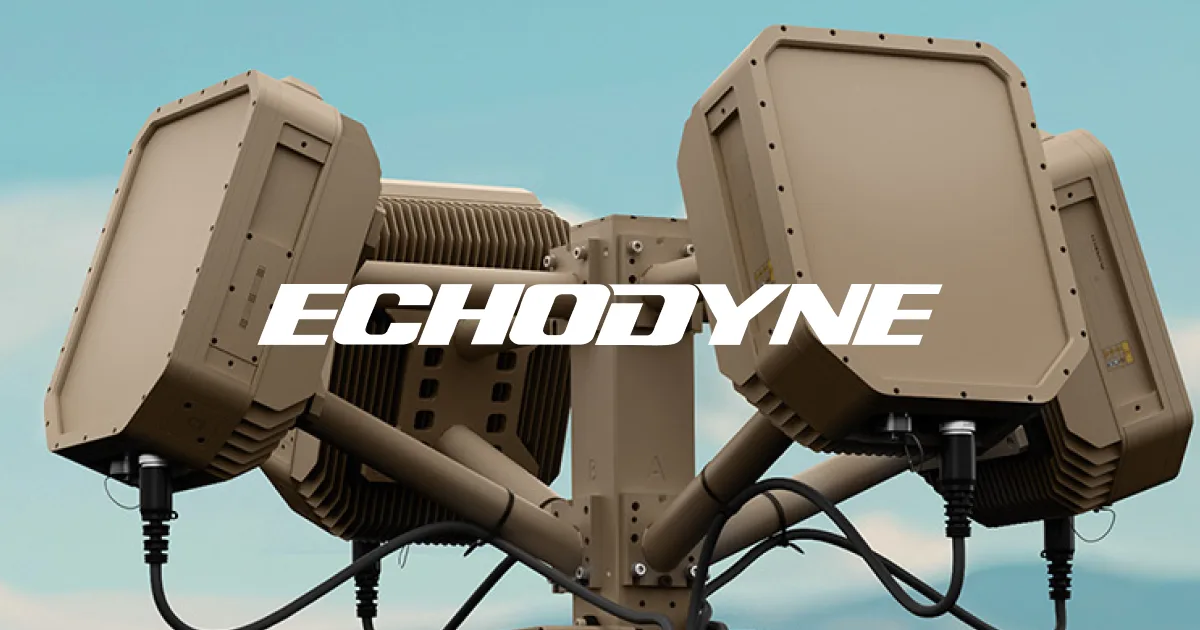
Echodyne designs and manufactures compact radars based on its patented Metamaterials Electronically Scanned Array, or MESA, technology. Instead of bulky radars that are physically turned on gimbals, it uses lightweight, solid-state panels. Defense News reported that the radars can track small quadcopter drones and more than 1,000 objects at once.
The radars are built into hundreds of counter-drone and security systems and are used by customers in more than 40 countries. Military customers fit them to remote weapon stations, high-energy lasers and high-power microwave weapons, where they guide interceptors toward incoming drones. Civilian buyers use them to watch for unauthorized drones over stadiums and airports and to support police and fire department drone flights.
In September 2026, Joint Interagency Task Force 401, the Defense Department's counter-drone task force, awarded Echodyne a 36-month contract with a ceiling of $250 million to supply counter-drone radars to U.S. and allied forces. The company recently opened an 86,350-square-foot factory, a $40 million investment that can produce about 30,000 radars a year. Shield's announcement placed it in Kirkland, while GeekWire said it is in Woodinville.
“Shield shares our view that autonomous systems can only act on what they can sense, and superior sensors lead to superior systems and outcomes.”
Why Shield is buying
Shield, founded in 2015, has organized itself around three business units: autonomy software, autonomous systems such as the V-BAT and X-BAT aircraft, and mission systems. The Echodyne deal expands mission systems into radar and counter-drone equipment, and Washington Technology noted it also reduces Shield's dependence on autonomy software revenue.
Frankenberg tied the deal to the link between sensing and autonomy, saying that better sensors produce better systems. Both companies said they expect triple-digit revenue growth in the current fiscal year. Frankenberg told Defense News in July that demand for counter-drone radar was very strong and could grow tenfold by 2030, pointing to the war in Ukraine as evidence of how drones have changed combat.
The deal also deepens Shield's presence in Washington state. In September, the company named Washington as the production home of the X-BAT, an AI-piloted, jet-powered aircraft, and GeekWire reported that it plans to build it in Des Moines, south of Seattle.
Paying for it
Shield is raising $2.5 billion alongside the deal. A $1 billion Series H at a post-money valuation of $28.8 billion is co-led by Disruptive and Innovation X Capital, with Advent, the Strategic Investment Group of JPMorganChase's Security and Resiliency Initiative, Snowpoint Ventures, Apandion and Center15 Capital taking part. Funds managed by Blackstone are adding $1 billion of structured equity, and JPMorgan Chase Bank is leading $500 million of debt as sole arranger. Most of the Series H money will go toward the acquisition.
GeekWire reported that the new valuation is more than double the one Shield carried months earlier, and that Madrona and other Echodyne investors will become significant Shield shareholders. J.P. Morgan Securities was Shield's exclusive financial adviser, with Wachtell, Lipton, Rosen & Katz as legal adviser. Morgan Stanley and Robert W. Baird advised Echodyne, with Fenwick & West as its legal counsel.
The founders and the funding
Echodyne spun out of Intellectual Ventures, the invention lab in Bellevue, Washington, in 2014. According to GeekWire, its first round of $15 million came from a group that included Bill Gates and Madrona Venture Group, and Madrona's early investment valued the company at $24 million before the money came in. Echodyne raised roughly $200 million over its lifetime and now has about 400 employees, up from 260 when its new factory opened in July.
GeekWire counted the purchase as Shield's fifth and largest acquisition, after Heron Systems, Martin UAV, Sentient Vision Systems and Aechelon Technology, which brought simulation software. Washington Technology gave a lower count, describing the deal as Shield's third, after the purchase of Crowdbotics' Pilot Analysis software business in April 2025 and of Aechelon in March 2026.