Movement, an Israeli wellness group, has acquired the technology and intellectual property of dacadoo, a Zurich digital health company whose platform is used by insurers, healthcare organisations and large employers. The deal was announced on November 5, 2026, in a press release datelined Geneva, and Swiss startup news site Startupticker reported it the next day.
The transaction was an asset purchase. Movement bought dacadoo's software and source code, while the Swiss company itself, dacadoo ag, is in liquidation. Neither side disclosed what movement paid. Swiss insolvency notices summarised by the business register site Moneyhouse showed that the bankruptcy administrators had a conditional purchase agreement for the core assets worth CHF 555,000 (about $690,000), excluding VAT, and had invited higher offers. The notices did not name the party behind that agreement.
According to the announcement, dacadoo's existing customers can keep using its platform, which will now sit alongside movement's own technology. The dacadoo website remained online under its own brand after the deal. Neither company said what would happen to dacadoo's staff.
What dacadoo built
Dacadoo was set up in Zurich in 2010 under the name QUENTIQ AG and took its current name in January 2012, according to its Wikipedia entry and the Swiss commercial register. Its founder, Peter Ohnemus, is described by Startupticker as an experienced internet entrepreneur. He also served as chief executive.
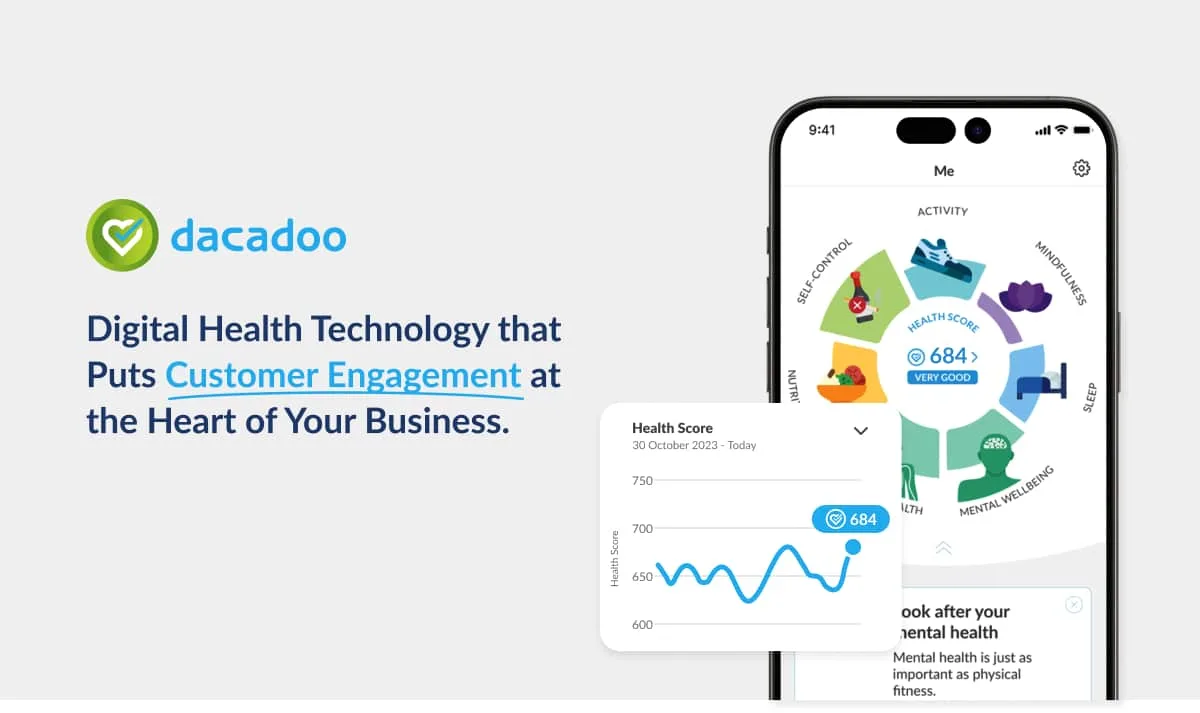
The company's main product is a digital health engagement platform that organisations offer to their own customers or staff under their own brand. Its best-known feature is the Health Score, a number between 0 and 1,000 based on physical health, mental wellbeing and lifestyle. Wikipedia notes the company describes it as a lifestyle product rather than a medical diagnostic tool. The platform added coaching, gamification and rewards, and dacadoo also sold the Health Score as a standalone API and a Risk Engine that helps insurers estimate health risk.
According to the press release, dacadoo spent 15 years building the platform, which is backed by 51 registered patents and used in dozens of countries, including the United States, Canada, Australia, Japan and Germany. Customer and partner logos on its website include Irish Life, AON, FICO, Albertsons, Nationwide and Generali. In May 2026 it announced a partnership with the Brazilian insurer Bradesco Vida e Previdência.
“We are pleased to have the opportunity to build on what dacadoo has created and to welcome its customers.”
From CHF 70 million in funding to bankruptcy
Dacadoo raised substantial venture money. Global Venturing reported in December 2019 that a Series C round had lifted its total funding to CHF 70 million (about $71 million at the time), although the size of that round and its investors were not disclosed. Samsung Venture Investment Corp backed the company's Series A in 2015, and Rakuten invested in 2017 through Rakuten Capital, according to the same report.
The company did not last. According to Moneyhouse, a Zurich bankruptcy office opened summary bankruptcy proceedings against dacadoo ag on July 29, 2026, and set November 16 as the deadline for creditor claims. The administrators planned a private sale of the key assets: the Health Score and Risk Engine software and source code, models and data, documentation, platform access rights, intellectual property and internet domains.
Under the terms published in the notices, rival bidders had until October 5 to beat the CHF 555,000 conditional agreement. Any competing bid had to be at least CHF 100,000 (about $125,000) higher and come with a CHF 500,000 (about $625,000) deposit. The board listed on the register at the time included Ohnemus, Hans Verstraete, Olav Ostin, David Vlerick and Mark B. Hoffman.
Why movement wanted it
Movement describes itself as a wellness company that works with employers, organisations and individuals. Its website lists three divisions: healthy lifestyle, which includes access to sports facilities and booking software for gyms; preventive healthcare, which covers corporate wellness programmes and habit-change apps; and retail. The group says it has more than 2,000 business clients, 2.5 million app users and over 280 employees.
Yogev Matok, chief executive of movement's wellbeing division, said the deal was part of a global expansion the group had recently announced. Movement said that adding dacadoo's technology and international customer base to its own products was a significant step in that growth. Matok said keeping service stable for dacadoo's customers was the first priority, alongside movement's experience in building and running fully branded behaviour-change platforms for large insurers, health funds and organisations.
The group also pointed to research on its own platforms. According to the release, a peer-reviewed study with researchers from Harvard Medical School and Tel Aviv University, published in Communications Medicine, found that users had an 18% lower incidence of type 2 diabetes, a 9% lower incidence of stroke and a 5% lower incidence of cardiovascular disease than matched non-users.