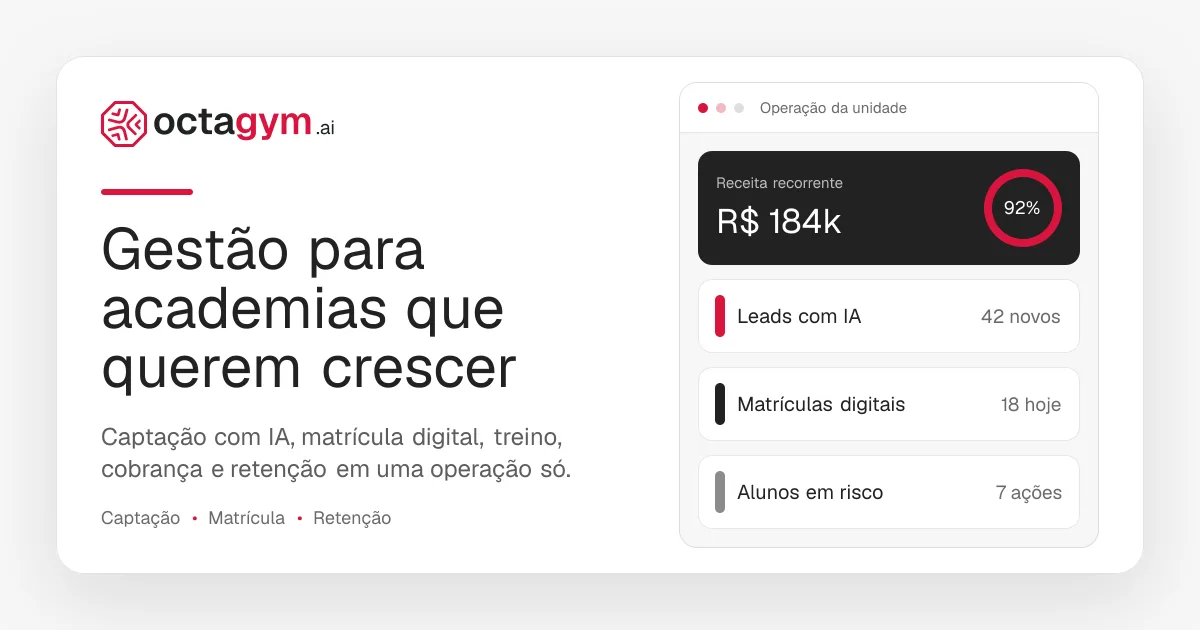
Pacto Soluções, a Brazilian company that makes management software for gyms, has acquired octagym.ai, an AI-native platform for gyms, studios and fitness chains. The deal was reported on November 19, 2026 by the Brazilian outlet UAI and by Dealroom. Pacto has renamed itself Pactogym Soluções after the purchase.
The price was not disclosed, according to Panorama Go Comunicação and Dealroom. octagym.ai's own website now carries a banner saying that Pacto bought octagym.ai and is now Pactogym.
octagym.ai becomes the group's main management system. Pacto's existing customers will be able to migrate to it voluntarily from December 2026, UAI reported.
What octagym.ai built
octagym.ai covers the full back office of a gym: winning new members, online enrolment, recurring billing, access control by facial recognition, finance, HR and member retention. Its AI agents answer sales leads that arrive through WhatsApp and run advertising campaigns on Meta's platforms, and the software connects to AI assistants including Claude and ChatGPT, according to UAI.
Co-founder Silvio Meireles Soares told UAI, in Portuguese, that many systems help gyms organise their operations, but octagym.ai is meant to help them sell more and lose fewer members.
The reports did not give octagym.ai's founding date, its city, its funding or the number of people who work there.
UAI listed the rest of the single system: tax management, purchasing, contracts, loyalty programmes, events and a member portal, with access control by QR code and NFC as well as facial recognition. For chains and franchisors it adds multi-unit management, network-wide standards, a consolidated income statement, budgeting and expansion tools.
Managers can check indicators and run parts of the business by talking to Claude or ChatGPT rather than opening separate screens, according to UAI. Soares said the platform lets gyms sell more and keep more members without stitching separate systems together, and that Pactogym gives it national scale.
Why Pacto is buying
Pacto has sold gym-management software in Brazil since 1999, according to UAI and Panorama Go. The group says it serves thousands of gyms with more than 2 million active users, including chains such as Ironberg, The Simple Gym, Live, Korpus, Corpo e Saúde and Greenlife, plus more than 80 other networks.
Its executive director said, in Portuguese, that combining with technology that was built around artificial intelligence from the start had become indispensable. UAI named him as Leonardo Borges, while a photo caption in another report gave a different surname.
Rather than rebuilding its own system, Pacto is moving its customer base onto the newer product and putting the acquired company's name at the centre of its new brand. Panorama Go reported that Pactogym says it is open to further acquisitions in the sector.
The founders stay
octagym.ai's three co-founders keep their roles inside the combined company. Silvio Meireles Soares is chief operating officer, Gustavo Ferreira Souza is chief technology officer and Thiago Vinicius Silva Santos is chief revenue officer, according to UAI and Dealroom.
The coverage did not name any outside investors in octagym.ai, and it is not clear whether the startup raised venture funding before the sale.
UAI cited industry figures from Fitness Brasil's Panorama Setorial Fitness, based on data from the federal physical education council CONFEF: the number of active registered physical activity businesses in Brazil grew from 22,581 in 2015 to 62,718 in July 2025. The same report said the group already runs payments and wearables operations.
What changes for gyms
For Pacto's current clients the switch is optional, at least at first. Gyms that move to octagym.ai from December will get the AI sales and retention tools; those that stay on the older Pacto system were not told how long it will be supported.
The reports gave few figures beyond the group's customer counts, and none on octagym.ai's revenue or user numbers before the deal. What they do show is a software vendor that has operated since 1999 choosing to move its customers onto an acquired AI-first product.