Windward, a maritime artificial intelligence company that tracks shipping for governments and commercial customers, has acquired Azimut.ai, an Israeli startup that identifies vessels from camera footage. Windward announced the deal on November 3, 2026, in a release issued from London and Washington.
Windward did not disclose the price or other terms. The release does not say whether Azimut.ai's founders and staff will join Windward or whether its product will keep its name.
Windward described the purchase as its first step into ground- and ship-based sensors. Until now, it has built its picture of activity at sea from transponder signals, satellite imagery and radio frequency data. With Azimut.ai, it plans to place cameras at busy shipping lanes and maritime chokepoints.
What Azimut.ai built
Azimut.ai turns the video from ordinary electro-optical and infrared cameras into live information about ships. Its software detects, classifies and tracks vessels and flags unusual activity, then sends alerts to control centres, according to its profile on Startupim, a database of Israeli startups. The product is called ALBATROSS and can combine marine cameras, drones, radar and the automatic identification system (AIS) signals that ships broadcast.
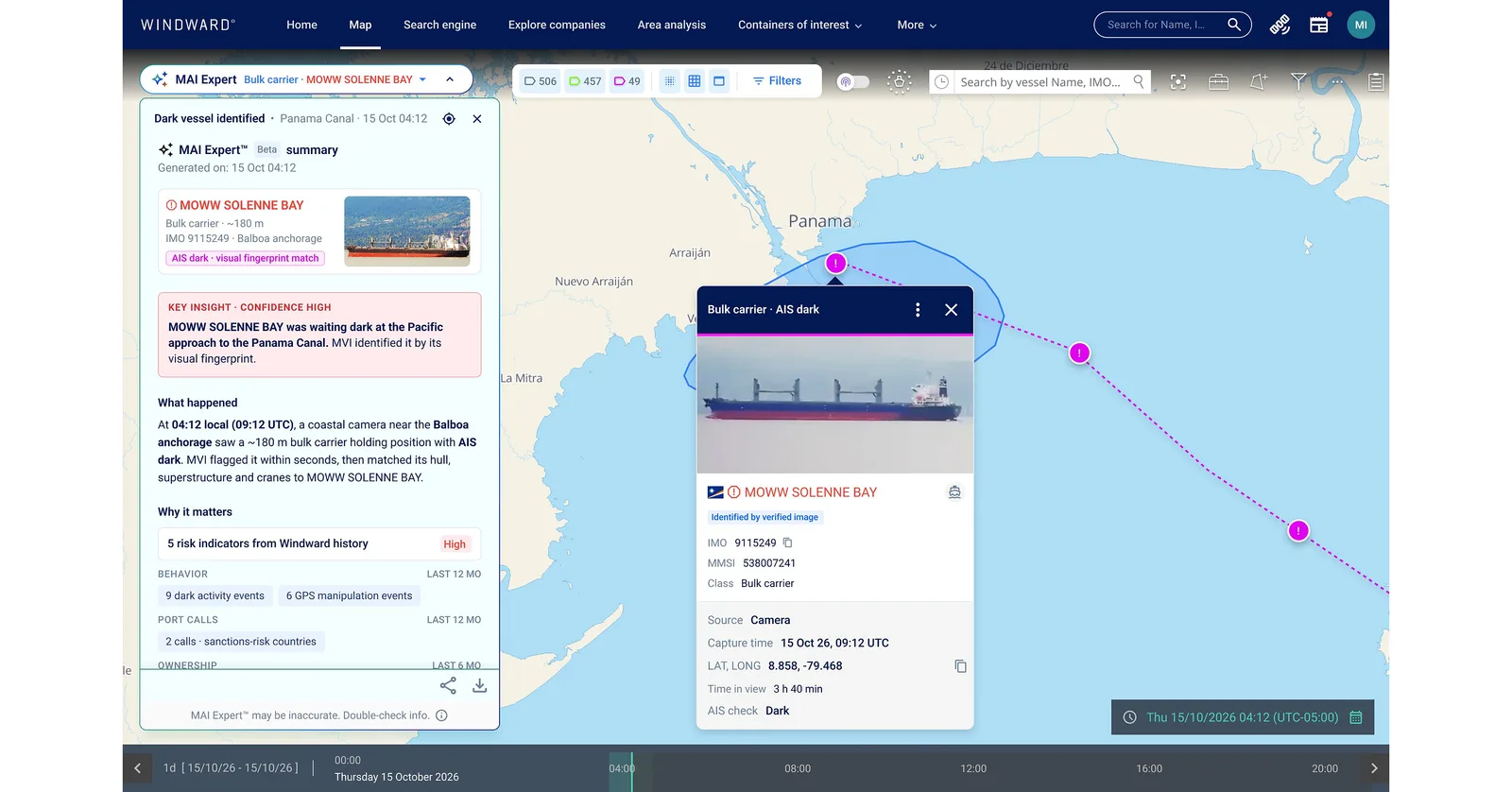
Windward said the technology can fingerprint and identify vessels in real time at ports and chokepoints, including ships that have turned off their AIS signals. Ships that go dark, spoof their position or sail through jammed waters are a growing problem for sanctions enforcement and port security, Runtime Wire noted in its report on the deal.
According to Unite.AI, which cited the company, the system works with existing cameras rather than new hardware, merges several cameras and sites into one map, and calculates a ship's position, course and speed from video alone. In a pilot at Israel's Ashdod Port, Azimut.ai reported detecting and documenting 464 targets at ranges of up to 7,000 metres with standard day cameras. These figures come from the company and were not independently verified.
Windward said the system does not give customers raw images or video. It is built to analyse vessel activity, not to identify or verify individual people.
“Owning these assets outright gives our customers a level of awareness and preparedness no one else can match.”
The founders and the company
Azimut.ai was incorporated in December 2020, according to Startupim. The database lists its headquarters in Petah Tikva and a registered address in Haifa. Its four co-founders are Matan Saat, the chief executive; Adi Gal, the chief revenue officer; Shay Lavi, the chief product officer; and Tomer Marom, the chief operating officer. All four previously served as officers in the Israeli Navy's marine patrol unit.
Startupim lists 13 employees, while Runtime Wire put the team at 12 in 2025. The amount of money Azimut.ai raised has not been clearly reported, and Windward did not mention the startup's investors.
Why Windward is buying
Windward combines AIS data, remote sensing, its own AI models and generative AI into a single view of activity at sea. Its customers include defence and intelligence agencies, law enforcement bodies and shipping and trading companies. Camera sightings from Azimut.ai will be matched with Windward's data on ship ownership, sanctions, cargo and behaviour, Dealroom reported.
Ami Daniel, Windward's chief executive and co-founder, said the company had spent years using AI to bring every maritime signal into one operational view. He said owning the sensors directly would give customers a level of awareness that rivals could not match.
Windward is also asking ports, terminal operators and other maritime organisations to become site partners that host its cameras. Daniel framed this as a community effort in the release.
A run of deals for Windward
Azimut.ai is the second acquisition Windward has announced in 2026. In April it bought Prominent Edge, a US defence technology company with geospatial expertise, according to Dealroom. Windward was taken private by FTV Capital in 2025, a deal that left it majority owned by US investors.
The purchase adds a physical layer to a business that has so far relied on data collected by others. Satellite pictures and transponder data can miss ships that hide their identity, and camera coverage at chokepoints is meant to close part of that gap. Windward did not say how many sites it plans to equip or when the combined service will be available to customers.