YellowFox, a German fleet telematics provider based in Kesselsdorf near Dresden, has acquired Peregrine.ai, a Berlin company that builds artificial intelligence software for vehicle cameras. Peregrine announced the deal on October 22, 2026, after the two companies had spent more than three years developing an AI-based video telematics product together.
The purchase price was not disclosed. According to Dealroom, venture investors Vektor Partners and Brandenburg Kapital, the investment arm of the state development bank ILB, sold their stakes along with Peregrine's founding team, and DZ Bank provided financing for the acquisition.
Peregrine will keep its brand, its technology portfolio and its Berlin office, and the company said nothing changes for its existing customers and partners. Its products will be developed further inside the YellowFox group.
What Peregrine built
Peregrine was founded in 2019 by Steffen Heinrich, Naja von Schmude and Jorit Schmelzle, who had previously worked on technology for autonomous vehicles in the automotive industry. Heinrich is the company's chief executive. Regional news site Oiger reported that the startup employs more than 20 people from eight countries.
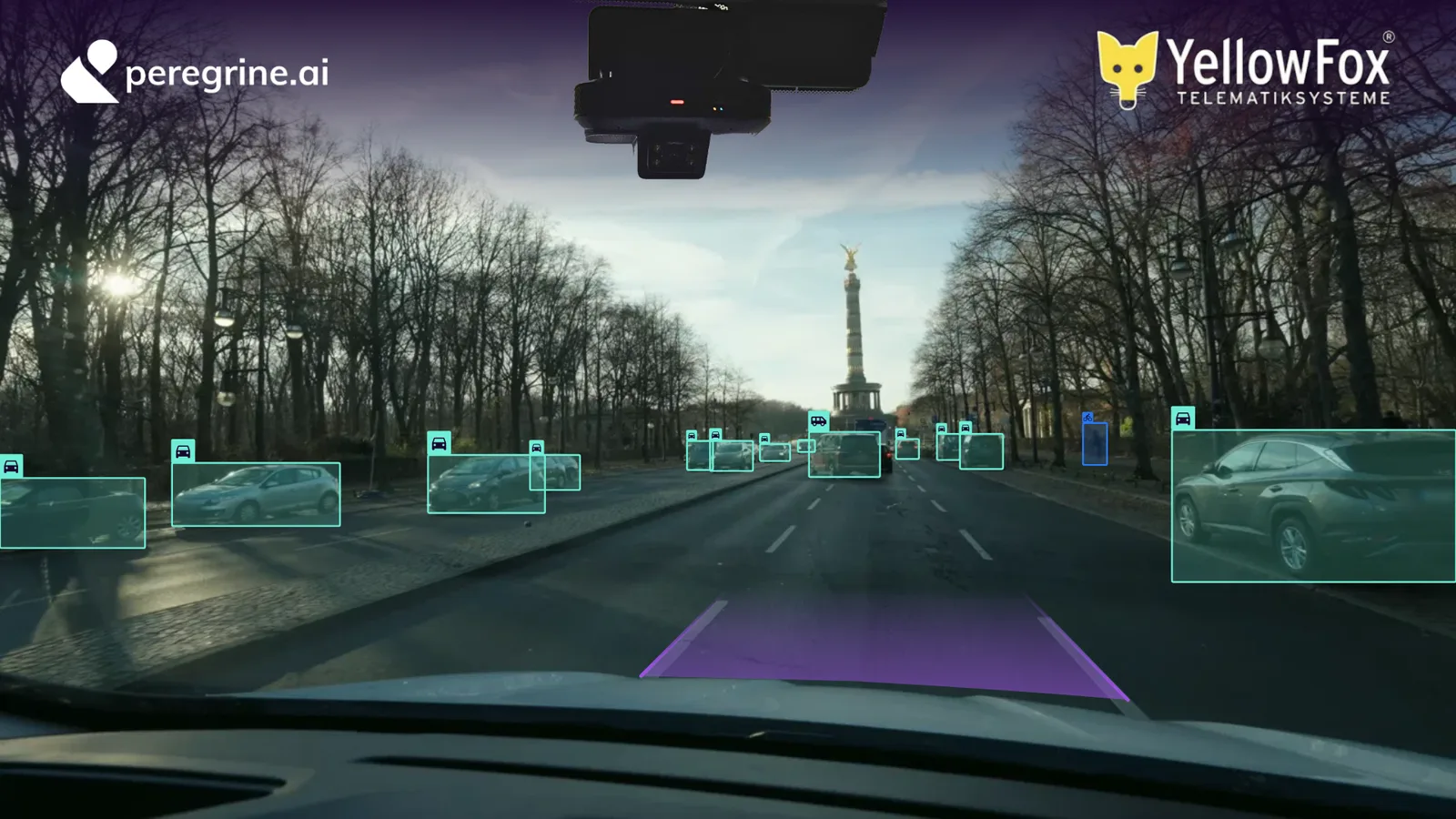
The company's software turns camera images into real-time information about what is happening around a vehicle. It combines image, vehicle and environmental data collected in public spaces, and Dealroom describes the software as GDPR-compliant and running on edge devices, meaning the processing happens close to the camera rather than in a remote data centre.
Fleets are not Peregrine's only market. The company also sells geodata products to cities and road authorities, offers security applications, and runs research partnerships in computer vision, robotics and AI with European institutions.
“Everything we offer our customers, we want to be able to do ourselves.”
The product the two companies share
The deal brings in-house the technology behind a video telematics product that YellowFox and Peregrine developed together. The system uses Peregrine's computer vision to analyse traffic situations, driving behaviour, the area around the vehicle and the vehicle interior in real time.
When it detects a potential hazard it warns the driver, and after an accident it records image-based documentation of what happened, according to Peregrine's announcement.
Until now YellowFox relied on Peregrine as an outside partner for that capability. Owning the company gives it direct control over the AI models and the engineers who build them.
Why YellowFox is buying
Hendrik Scherf, YellowFox's founder and managing director, framed the deal as a question of control over the company's own technology. "Everything we offer our customers, we want to be able to do ourselves," he said in Peregrine's announcement. Speaking to Oiger, he called the acquisition the logical next step in the company's history.
Heinrich said the combination would speed up product work for commercial vehicle operators. "Together, we can develop practical solutions for professional fleets more quickly," he said.
YellowFox was founded in 2003 and sells cloud-based telematics for managing vehicle fleets, equipment and field staff through a modular software portfolio. Peregrine's announcement puts its scale at more than 125,000 connected vehicles and 125 employees, serving customers across the German-speaking DACH region through a partner network. Oiger gave slightly higher figures, of about 140 staff at the headquarters and more than 140,000 systems in use across Europe.
Scherf, a trained car mechanic, started the business in the 1990s with a partner in Freital before founding YellowFox in 2003, Oiger reported. Buying Peregrine gives the company its own AI development team in Berlin alongside its telematics operation in Saxony.
Who owns the buyer
YellowFox's majority owner is Peter Möhrle Holding, a Hamburg family investment company, which Dealroom said is backing the telematics firm's growth. The deal was reported by Dealroom on October 21, a day before Peregrine published its own announcement.
For Peregrine's venture backers, the sale ends an investment in a startup that had found its main commercial outlet through one industrial partner. Neither the companies nor Dealroom disclosed how much Peregrine had raised before the sale.